Eris, Makemake and Haumea are dwarf planets located behind Pluto, in areas of the solar system known as scattered disk and Kuiper Belt. They are known as dwarf planets likewise Ceres and Pluto, but unlike these two have not been seen in sufficient detail to show that completely fit the definition of planets. Eris has a mass larger than Pluto and Makemake and Haumea are still under investigation. Besides these three bodies fall into a new category called "plutinos" or "trans-" by many. Although the IAU does not specify a specific name, are often referred to by the abbreviation TNO (Trans neptunian object). This category of objects similar to Pluto only applies to dwarf planets if they are trans-Neptunian objects and their periods, inclinations and eccentricity are similar to those of Pluto and therefore are on the scattered Disk, the Kuiper Belt or the Oort Cloud. In addition, there are a few bodies who are candidates for recognition as "dwarf planets" ...
Picture by/Imagen de Christina Balit Saturn was a god in ancient Roman religion. Saturn is a complex figure because of his multiple associations and long history. He was the first god of the Capitol, known since the most ancient times and was seen as a god of generation, dissolution, plenty, wealth, agriculture, periodical renewal and liberation. In later developments he came to be also a god of time. The Romans identified Saturn with the Greek Cronus, whose myths were adapted for Latin literature and Roman art. Saturn had two consorts who represented different aspects of the god. Ops, the equivalent of Greek Rhea that means "wealth, abundance, resources." and Lua that means "destruction, dissolution, loosening". Saturday is derived from Saturn as well as the adjective saturnine (gloomy) related to his role in mythology and astrology. ___________________ Saturno era un dios de la antigua religión romana. Es una figura compleja, debido a sus múltiples aso...
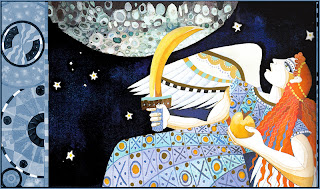
Picture by/Imagen de Christina Balit Eris was the goddess or of strife, discord, contention and rivalry. She was often represented specifically as the demon of the strife of war, who haunted the battlefield and delighted in human bloodshed. She was the sister of Ares and usually attended wars with him. Eris' Roman counterpart was Discordia. Because of Eris' disagreeable and trouble-maker nature she was the only goddess not to be invited to the wedding of Peleus and Thetis. Despite of that, she turned up anyway, and when she was refused admittance, she, in a rage, threw a golden apple amongst the goddesses inscribed "To the fairest." Three goddesses laid claim it, and in their rivalry brought about the events which led to the Trojan War. _____________________ Eris era la diosa de la lucha, la discordia, la contención y la rivalidad. Se la representada a menudo específicamente como un demonio de la lucha y de la guerra, que hechizaba a los guerreros en el c...


Comentarios
Publicar un comentario