Entradas

Mostrando las entradas etiquetadas como Júpiter

The mythology of Jupiter / Mitología de Júpiter

Imagen
Picture by/Imagen de Christina Balit In ancient Rome, Jupiter was the king of the gods and the god of sky, lightning and thunder. He was the chief deity of Roman state religion throughout the Republican and Imperial eras, until Christianity became the dominant religion of the Empire. The Romans regarded Jupiter as the equivalent of the Greek Zeus, and after the fusion, became also the god of law, order and justice. He was the son of Saturn and Ops, and like in Greek mythology he defeated his father. The day of the week Jueves derives from him. He presided the realm of the sky. __________________ En la antigua Roma, Júpiter era el rey de los dioses y el dios del cielo, los relámpagos y los truenos. Era el principal deidad de la religión del estado romano a lo largo de las épocas republicanas e imperiales, hasta que el cristianismo se convirtió en la religión dominante del Imperio. Los romanos consideraban a Júpiter como el equivalente del Zeus griego, y después de la fusión, s...

Planets Summary / Los planetas del sistema solar

If you found difficult or extensive my explanations of the planets, you'll find a summary of each of them in the following power point. Enjoy. ____________ Si te han parecido difíciles o extensas las explicaciones sobre los planetas, encontrarás un resumen de cada uno de ellos en el siguiente power point. Que lo disfrutes. Los planetas del sistema solar View more presentations from manisero399 .

Pictures of the Solar System / Fotos del Sistema Solar

Imagen
If you want to see stunning pictures of the Solar System provided by NASA click below and discover the wonders of our system. Si quieres ver unas fotos impresionantes del Sistema Solar de la NASA haz click debajo y descubre de cerca las maravillas de nuestro sistema. Visit My Photos - 26 Pics Fotos del Sistema Solar

Solar System in English

Imagen
If you want to know how to call the different parts of the solar system in English, click on the image. Si quieres saber como se llaman las diferentes partes del Sistema Solar en Inglés, haz click en la imagen.

Planetary System for kids / Explicación del Sistema Solar para niños

If you have found the above explanations  difficult, you can check this link of science education for children and read the explanation given about the solar system. http://educa-ciencia.com/sistema-solar-primaria.htm Si las explicaciones anteriores te han sido difíciles, puedes consultar esta página de educa-ciencia y leer la explicación para niños que se da sobre el Sistema Solar.

A walk through our Solar System / Paseo por el Sistema Solar

In the following link, you will find an entertaining tour through the Solar System, with allits major bodies. It's interesting to see in scale the distance between planets. Note that Eris is called Xena (provisional name when it was discovered). Makemake and Haumea had not yet been classified as dwarf planets when this program first saw the light. Hope you like it. To take the tour, click the link below: ___________________ En el siguiente link, encontraréis un entretenido paseo por el Sistema Solar, con los planetas más importantes. Es interesante ver "a escala" la distancia entre planetas. Observad que Eris es llamado Xena (su nombre provisional cuando fue descubierto). Makemake y Haumea aún no habían sido catalogados como planetas enanos cuando se realizó este programa. Espero que os guste. Para dar el paseo, pincha aquí: Paseo por el Sistema Solar

Jupiter / Júpiter

Imagen
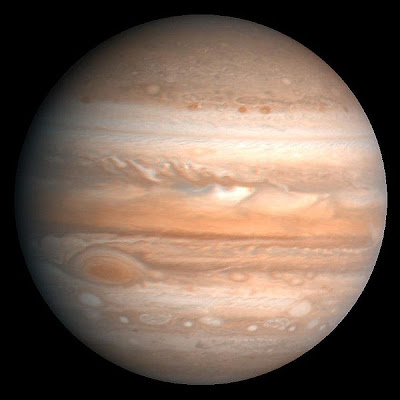
Jupiter is the fifth planet in distance from the sun. It is part of the so-called gaseous planets. It is the largest of the planets in the Solar System. It is known for its stripped atmosphere. One of the most marked features is the Great Red Spot, which has been known since 1664. Jupiter's atmosphere does not have a clear boundary with the liquid inside the planet. It is composed mostly of hydrogen and helium, and contain traces of methane, water vapor, ammonia, and hydrogen sulfide. In the planet's interior we find hydrogen, helium and argon progressively compressed, and it is believed to exist beneath a rocky core composed mainly of ice and denser materials about seven Earth masses. Jupiter has at least 63 moons. The ones called Galilean (Io, Europa, Ganymede and Callisto) resemble inner solar system planets by size and composition. Its diameter is 139,892 km and it takes almost 12 Earth years to circle the Sun ________________________ Júpiter es el quinto plan...