Entradas

Mostrando las entradas etiquetadas como Planetas Rocosos

Life On Mars?

Imagen
Organic molecules on Mars could have a biological origin.😲 https://www.sciencealert.com/organic-molecules-on-mars-could-have-a-biological-origin Suelo marciano fotografiado por el robot curiosity.  (Foto: NASA JPL / Caltech / MSSS) https://noticiasdelaciencia.com/art/37192/unas-moleculas-organicas-descubiertas-en-marte-encajan-con-la-existencia-de-vida-temprana-en-el

Seven Earth-sized planets discovered orbiting a neighbour star

Imagen
This discovery has raised hopes of finding alien life beyond our solar system much sooner than previously expected, with a new generation of telescopes expected for the next decade. It is the very first time that so many Earth-sized planets (seven) have been found orbiting around the same star. A  part from the size, other conditions, such as distance to the sun or the fact that we are dealing with rocky planets, resemble our own  home. Illustration: NASA/JPL-Caltech

NASA Confirms Evidence Of Liquid Water In Mars

Imagen
NASA Confirms Evidence That Liquid Water Flows on Today’s Mars : New findings from NASA's Mars Reconnaissance Orbiter (MRO) provide the strongest evidence yet that liquid water flows intermittently on present-day Mars.

Tour Weird Ceres

Imagen
The Mysteries of Ceres: Tour Weird Ceres: Bright Spots and a Pyramid-Shaped Mountain

Dry Ice Moves on Mars

Imagen
Scientists have discovered water on Mars!

Pluto Real Images

Imagen
Nasa's New Horizons spacecraft has sent back detailed images of Pluto and its moon Charon. The pictures have been captured from a mere 8m kilometres. http://astronomynow.com/wp-content/uploads/2015/07/nh-colour-pluto-charon_1212x744.jpg

The mythology of Mars / Mitología de Marte

Imagen
Picture by/Imagen de Christina Balit Under the influence of Greek culture, Mars was identified with the Greek god Ares. In ancient Roman religion and myth, Mars was an agricultural god guardian that later developed war characteristics due to Greek influence. He was second in importance only to Jupiter, and he was the most prominent of the military gods in the religion of the Roman army. Virility was another essential characteristic of Mars. Most of his festivals were held in March, the month named for him, the day of the week Martes, is also named after him. Contrary to his Greek counterpart, Mars was the son of Juno alone. The word martial for instance, derives from Mars. ______________ Bajo la influencia de la cultura griega, Marte fue identificado con el dios griego Ares. En la antigua religión romana y su mito, Marte era un dios guardián agrícola que posteriormente desarrolló características guerreras debido a la influencia griega. Era el segundo en importancia después d...

The mythology of Venus / Mitología de Venus

Imagen
Picture by / Imagen de Christina Balit Venus is the Roman counterpart to the Greek Aphrodite. Venus embodies sex, love, beauty, enticement, seduction, and persuasive female charm among the community of immortal gods. In Roman mythology, she was the mother of the Roman people through her son, Aeneas, who survived the fall of Troy and fled to Italy. In myth, Venus was born of sea-foam. Roman theology presents Venus as the yielding, watery female principle, essential to the generation and equilibrium of life. The root of her name traces back to indoeuropean wen- ; to strive after, wish, desire, be satisfied. The Spanish day of the week Viernes is dedicated to her. Words like venerable or veneration come from the goddess. ______________ Venus es el equivalente romano de la diosa griega Afrodita. Venus representa el sexo, el amor, la belleza, el encanto, la seducción y la persuasión femenina en el panteón de dioses inmortales romanos. En la mitología romana, era la madre del pu...

The mythology of Mercury / La mitología de Mercurio

Imagen
Picture by/Imagen de Christina Balit. Mercury is the Roman version of the Greek Hermes. He is the patron god of financial gain, commerce, eloquence, communication, travelers, boundaries, luck, trickery and thieves; furthermore he is also the guide of souls to the underworld. He was considered the son of Maia and Jupiter in Roman mythology. His name is related to the Latin word merx (merchandise, merchant, commerce, etc.). In Spanish the day of the week Miércoles, is dedicated to him. Mercury has influenced the name of many things in scientific fields, such as the planet Mercury, and the element mercury. The word mercurial is commonly used to refer to something or someone erratic, volatile or unstable, derived from Mercury's role both in mythology and astrology in ancient times. ___________________ Mercurio es la versión romana del Hermes griego. Es el dios de las ganancias financiera, el comercio, la elocuencia, la comunicación, los viajeros, las fronteras, la suerte, el ...

Planets Summary / Los planetas del sistema solar

If you found difficult or extensive my explanations of the planets, you'll find a summary of each of them in the following power point. Enjoy. ____________ Si te han parecido difíciles o extensas las explicaciones sobre los planetas, encontrarás un resumen de cada uno de ellos en el siguiente power point. Que lo disfrutes. Los planetas del sistema solar View more presentations from manisero399 .

Pictures of the Solar System / Fotos del Sistema Solar

Imagen
If you want to see stunning pictures of the Solar System provided by NASA click below and discover the wonders of our system. Si quieres ver unas fotos impresionantes del Sistema Solar de la NASA haz click debajo y descubre de cerca las maravillas de nuestro sistema. Visit My Photos - 26 Pics Fotos del Sistema Solar

Solar System in English

Imagen
If you want to know how to call the different parts of the solar system in English, click on the image. Si quieres saber como se llaman las diferentes partes del Sistema Solar en Inglés, haz click en la imagen.

Planetary System for kids / Explicación del Sistema Solar para niños

If you have found the above explanations  difficult, you can check this link of science education for children and read the explanation given about the solar system. http://educa-ciencia.com/sistema-solar-primaria.htm Si las explicaciones anteriores te han sido difíciles, puedes consultar esta página de educa-ciencia y leer la explicación para niños que se da sobre el Sistema Solar.

A walk through our Solar System / Paseo por el Sistema Solar

In the following link, you will find an entertaining tour through the Solar System, with allits major bodies. It's interesting to see in scale the distance between planets. Note that Eris is called Xena (provisional name when it was discovered). Makemake and Haumea had not yet been classified as dwarf planets when this program first saw the light. Hope you like it. To take the tour, click the link below: ___________________ En el siguiente link, encontraréis un entretenido paseo por el Sistema Solar, con los planetas más importantes. Es interesante ver "a escala" la distancia entre planetas. Observad que Eris es llamado Xena (su nombre provisional cuando fue descubierto). Makemake y Haumea aún no habían sido catalogados como planetas enanos cuando se realizó este programa. Espero que os guste. Para dar el paseo, pincha aquí: Paseo por el Sistema Solar

Mars / Marte

Imagen
Mars is also called the Red Planet and is the fourth planet from the Sun. It is part of the so-called rocky planets like Earth and is in many aspects the planet most alike the Earth. The atmosphere of Mars is a hundredth of the one of the Earth and its composition is essentially: carbon dioxide in a high percentage with some nitrogen, argon and molecular oxygen. The ozone content is 1000 times lower than the Earth, so that the layer is unable to block ultraviolet radiation. Its atmosphere is dense enough to hold strong winds and vast dust storms that can eventually encompass the entire planet for months creating sand dunes, common renderings in Martian deserts. Mars has two small moons, whose orbit is very close to the planet, Phobos and Deimos. It takes 687 days to orbit around the sun. Its diameter is 6780 km. ___________________________ Marte es también llamado el Planeta Rojo y es el cuarto planeta del Sistema Solar. Forma parte de los llamados planetas rocosos como la Tierra...

Earth / La Tierra

Imagen
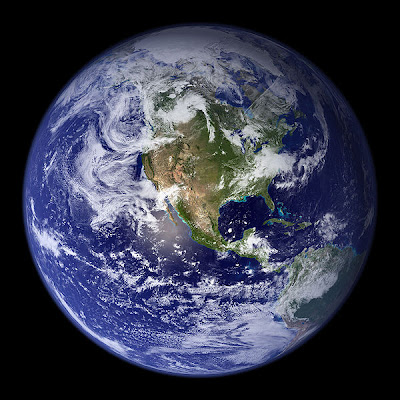
The Earth is the third planet in proximity to the Sun and it is the densest and fifth-largest of the planets in the Solar System. It is a rocky planet and the only hitherto known with existence of life as millions of species living in it. The Earth has a thick atmosphere composed by 78% nitrogen, 21% oxygen and 1% molecular argon, plus traces of other gases such as carbon dioxide and water vaporized. The atmosphere lets in sunlight turn trapping terrestrial radiation, producing the greenhouse effect. Thanks to this, the Earth's average temperature is about 17 ° C. The Earth's atmospheric composition is maintained by the biosphere, thanks to the large amount of free oxygen produced by plants through photosynthesis, which by the action of sunlight transforms CO2 into O2. Free oxygen in the atmosphere is the result of the presence of life on earth and not vice versa. The Moon is the only natural satellite of the Earth, with an average distance of 384,400 km. As the size differen...

Venus

Imagen
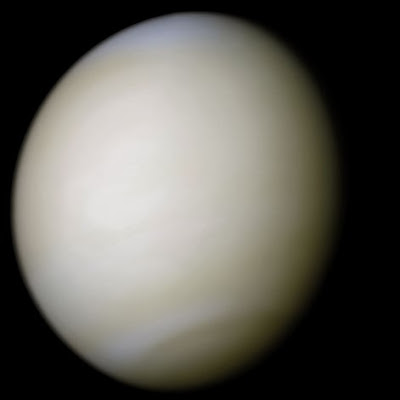
Venus is the second planet of our solar system in order of distance from the Sun. It is a terrestrial planet very similar to Earth, as both coincide in size, mass and composition. Venus orbit is an ellipse with an eccentricity of less than 1%, which is practically a circumference. Venus has a dense atmosphere, composed mostly of carbon dioxide and nitrogen in smaller amounts. The pressure at the surface level is 90 times the atmospheric pressure at the Earth's surface and its large amount of CO2 in the atmosphere causes a strong greenhouse effect that raises the surface temperature of the planet to about 464 ° C. Venus rotates on itself in a retrograde movement in the same direction clockwise, from east to west instead of west to east as almost all the planets, taking a walk in the sun land 224.701 days.  ____________________ Venus es el segundo planeta del Sistema Solar en orden de distancia desde el Sol y es un planeta de tipo terrestre muy similar a la Tierra, ya que a...

Mercury / Mercurio

Imagen
Mercury is the planet of the solar system closest to the Sun and the smallest with the exception of the dwarf planets. It is one of the rocky planets and has no satellites. Has a lighter atmosphere consisting of potassium, sodium and other elements. The pressure of the atmosphere is a hundred thousandth of the atmospheric pressure on the surface of the earth. Perhaps because of being a small planet its gravity is insufficient to hold for long periods of time major atmospheric density. Mercury has an orbital period of about 88 Earth days. Because Mercury's orbit lies within Earth's orbit, it can appear in Earth's sky in the morning or the evening, but never in the middle of the night. _________________ Mercurio es el planeta del Sistema Solar más próximo al Sol y el más pequeño a excepción de los planetas enanos. Es uno de los planetas rocosos y no tiene satélites. Tiene una liviana atmósfera constituida por potasio, sodio y otros elementos. La presión de la atmósfera...

Planets of the Solar System / Los Planetas del Sistema Solar

Imagen
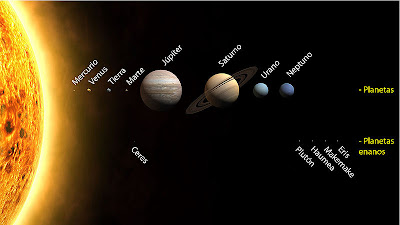
A planet is an astronomical object orbiting a star (the Sun in our Solar system) or stellar remnant  that is massive enough to be rounded by its own gravity. The planets in our system might be divided in three groups according to the IAU definition of planet of 2006: - Inner terrestial rocky planets: Mercury, Venus, Earth and Mars. - Outer gas giant Planets: Jupiter, Saturn, Uranus and Neptune.  - Dwarf planets: Ceres, Pluto, Eris, Makemake and Haumea. According to the IAU resolution, the definition of planet in the Solar System set in 2006 states that a planet is a celestial body which: is in orbit around the Sun, has sufficient mass to assume hydrostatic equilibrium (a nearly round shape) is not a satellite of a planet or any other stellar body. There is a forth rule, much discussed, that sets a difference between dwarf planets and the classical ones: has "cleared the neighbourhood" around its orbit. Bodies which fulfill the first two...

Funny video about the planets in our Solar system / Entretenido video sobre los planetas del Sistema Solar

Imagen
Here you have a funny video about the planets that form our solar system; in which we see the eight planets and five dwarf planets  according to their distance from the Sun. The video is accompanied by music to make it more entertaining and information about their diameter and location in English. Hope you enjoy. ______________________ Aquí os dejo un entretenido video sobre los planetas del Sistema Solar en el que vemos, de manera tridimensional, a los ocho planetas  y a los cinco planetas enanos que lo forman, según su distancia desde el Sol. El vídeo va acompañado de música para hacerlo más ameno y de información sobre su diámetro y situación, eso sí, en inglés. Espero que lo disfrutéis.