Entradas

Mostrando las entradas etiquetadas como Uranus

The mythology of Uranus / Mitología de Urano.

Imagen
Picture by/Imagen de Christina Balit Uranus was the primal Greek god personifying the sky. His equivalent in Rome was Caelus. In Ancient Greek literature, he was the son and husband of Gaia, the Mother Earth. Uranus was conceived by Gaia alone, but both were the parents of the first generation of Titans, and so, the ancestors of most of the Greek gods. Nevertheless no cult addressed directly to Uranus survived into Classical times, and Uranus does not appear among the usual themes of Greek painted pottery. Nevertheless he is remembered for his role one important myth, the birth of Aphrodite. In the most famous version of the myth, her birth was the consequence of a castration: Cronus severed Uranus' genitals and threw them behind him into the sea. The foam from his genitals gave rise to Aphrodite. It is anomalous that, while the other planets take Roman names, Uranus is a name derived from Greek. In the 19th-century the term uranian was referred to a person with problems of...
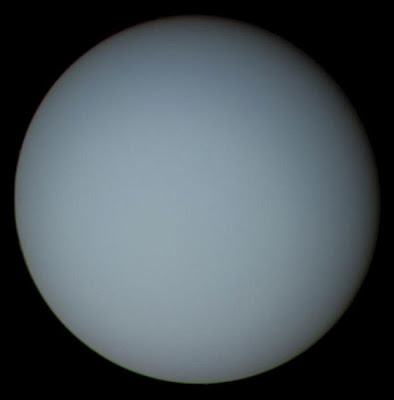
Uranus / Urano

Imagen
Uranus is the seventh planet from the Sun and the third largest. The main feature of Uranus is the inclination of its axis almost ninety degrees with respect to its orbit, an inclination which is not only limited to the same planet, but its rings, satellites and magnetic field. Uranus has the most uniform surface of all the planets by their characteristic blue-green color produced by the combination of gases in its atmosphere. Although at first glance it may not seem, it has a system of rings, including one blue. It is also a gaseous planet. As happens with Venus, Uranus has a retrograde motion, turning clockwise. The planet has an atmosphere formed by a mixture of hydrogen and helium and traces of methane (being about 15% of its planetary mass) and the mantle would be formed by ice and chemical oceans, water, ammonia and methane, providing a high electrical conductivity. Uranus has 27 known moons, Titania and Oberon being the largest with a similar size (1580 and 1520 km in diameter...