Entradas

Mostrando las entradas etiquetadas como La Luna

The mythology of the Moon / Mitología de la Luna
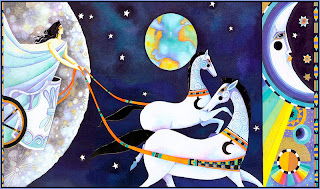
Imagen
Picture by/Imagen de Christina Balit In ancient Roman religion and myth, Luna is the divine embodiment of the Moon. She is often presented as the female complement of the Sun (Sol) conceived of as a god. Luna is also sometimes represented as an aspect of the Roman triple goddess (diva triformis), along with Proserpina and Hecate. Luna is not always a distinct goddess, but sometimes rather an epithet that specializes a goddess, since Diana and Hecate are  also identified as moon goddesses. Luna's Greek counterpart was Selene, and Diana's was Artemisa. The celestial character of Diana is reflected in her connection with moonlight, inaccessibility and her preference for dwelling on high mountains and in sacred woods. Diana therefore reflects the heavenly world in its sovereignty and supremacy but at the same time, she is seen as active in ensuring the succession of kings and in the preservation of humankind through the protection of childbirth. As a goddess of hunting, Di...

Pictures of the Solar System / Fotos del Sistema Solar

Imagen
If you want to see stunning pictures of the Solar System provided by NASA click below and discover the wonders of our system. Si quieres ver unas fotos impresionantes del Sistema Solar de la NASA haz click debajo y descubre de cerca las maravillas de nuestro sistema. Visit My Photos - 26 Pics Fotos del Sistema Solar

Planetary System for kids / Explicación del Sistema Solar para niños

If you have found the above explanations  difficult, you can check this link of science education for children and read the explanation given about the solar system. http://educa-ciencia.com/sistema-solar-primaria.htm Si las explicaciones anteriores te han sido difíciles, puedes consultar esta página de educa-ciencia y leer la explicación para niños que se da sobre el Sistema Solar.

The Moon / La Luna

The Moon is the only natural satellite of the Earth. It is the largest natural satellite of a planet in the Solar System relative to the size of its primary .  The Moon is in synchronous rotation with Earth, always showing the same face with its near side marked by dark volcanic Maria that fill between the bright crustal highlands and impact craters. It is the brightest object in the sky after the Sun from the Earth, although its surface is actually dark, we see it bright because of reflectance. The average distance between the center of the Earth and the Moon is 384,400 km and a diameter of 3,476 km, a quarter of the Earth. The Moon is a differentiated body: it has a  crust, a mantle, and a solid iron-rich inner core. It takes our Moon about 29.5 days to completely cycle through all eight phases. Occasionally (about every 2.7 years) there are two Full Moons in the same month. This is referred to as a Blue Moon. Hence the saying "Once in a Blue Moo...