Entradas

Mostrando las entradas etiquetadas como La Tierra

The mythology of the Earth / Mitología de la Tierra
Imagen
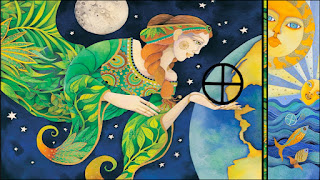
Picture by/Imagen de Christina Balit In ancient Roman religion and myth Terra Mater ("Mother Earth") was the goddess of the earth, one of the the twenty principal gods of Rome, and one of the twelve agricultural deities. She is regularly associated with Ceres in rituals pertaining to the earth and agricultural fertility. Her attributes were the cornucopia, bunches of flowers or fruit. She was typically depicted reclining. Her Greek counterpart was Gaia, the great mother of all: the primal Greek Mother Goddess; creator and giver of birth to the Earth and all the Universe; the heavenly gods, the Titans and the Giants. ___________________ En la antigua religión y mitología romana Terra Mater ("Madre Tierra") era la diosa de la tierra, uno de los veinte principales dioses de la antigua Roma y una de los doce deidades agrícolas. Se la asociaba regularmente con Ceres en ritos relacionados con la tierra y la fertilidad agrícola.Sus atributos son el cuerno de l...

Translational and rotational movements / Movimientos de traslación y rotación

The Earth takes 23 hours 56 minutes exactly to turn fully around its axis, which passes through the poles, in west-east direction and in the opposite direction of clockwise. This is called rotation. In addition, this move gives us the feeling that the sky is swirling around our planet.The translational motion is an important movement of the earth, by which our planet moves around the Sun, driven by gravitation, in a time of 365 days, 5 hours and 57 minutes, which is the actual length of the year.The axis of rotation of the Earth is always pointing to an inclined direction. So when in its orbit around the Sun's north pole points toward the Sun, the northern hemisphere receives more heat, while in the Southern hemisphere we get some cold. Below you'll find a fun and short video that explains everything you need on the subject, I hope you like it. _________________ La Tierra tarda 23 h 56 minutos exactamente en dar una vuelta completa alrededor de su propio eje, que pasa ...

Planets Summary / Los planetas del sistema solar

If you found difficult or extensive my explanations of the planets, you'll find a summary of each of them in the following power point. Enjoy. ____________ Si te han parecido difíciles o extensas las explicaciones sobre los planetas, encontrarás un resumen de cada uno de ellos en el siguiente power point. Que lo disfrutes. Los planetas del sistema solar View more presentations from manisero399 .

Pictures of the Solar System / Fotos del Sistema Solar

Imagen
If you want to see stunning pictures of the Solar System provided by NASA click below and discover the wonders of our system. Si quieres ver unas fotos impresionantes del Sistema Solar de la NASA haz click debajo y descubre de cerca las maravillas de nuestro sistema. Visit My Photos - 26 Pics Fotos del Sistema Solar

Solar System in English

Imagen
If you want to know how to call the different parts of the solar system in English, click on the image. Si quieres saber como se llaman las diferentes partes del Sistema Solar en Inglés, haz click en la imagen.

Planetary System for kids / Explicación del Sistema Solar para niños

If you have found the above explanations  difficult, you can check this link of science education for children and read the explanation given about the solar system. http://educa-ciencia.com/sistema-solar-primaria.htm Si las explicaciones anteriores te han sido difíciles, puedes consultar esta página de educa-ciencia y leer la explicación para niños que se da sobre el Sistema Solar.

A walk through our Solar System / Paseo por el Sistema Solar

In the following link, you will find an entertaining tour through the Solar System, with allits major bodies. It's interesting to see in scale the distance between planets. Note that Eris is called Xena (provisional name when it was discovered). Makemake and Haumea had not yet been classified as dwarf planets when this program first saw the light. Hope you like it. To take the tour, click the link below: ___________________ En el siguiente link, encontraréis un entretenido paseo por el Sistema Solar, con los planetas más importantes. Es interesante ver "a escala" la distancia entre planetas. Observad que Eris es llamado Xena (su nombre provisional cuando fue descubierto). Makemake y Haumea aún no habían sido catalogados como planetas enanos cuando se realizó este programa. Espero que os guste. Para dar el paseo, pincha aquí: Paseo por el Sistema Solar

Earth / La Tierra

Imagen
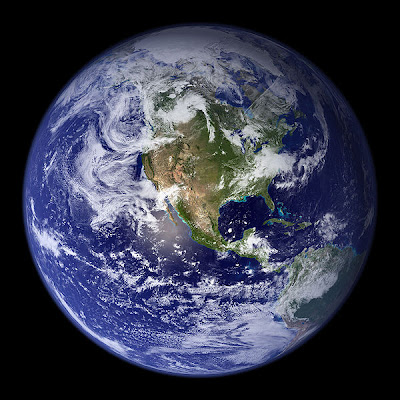
The Earth is the third planet in proximity to the Sun and it is the densest and fifth-largest of the planets in the Solar System. It is a rocky planet and the only hitherto known with existence of life as millions of species living in it. The Earth has a thick atmosphere composed by 78% nitrogen, 21% oxygen and 1% molecular argon, plus traces of other gases such as carbon dioxide and water vaporized. The atmosphere lets in sunlight turn trapping terrestrial radiation, producing the greenhouse effect. Thanks to this, the Earth's average temperature is about 17 ° C. The Earth's atmospheric composition is maintained by the biosphere, thanks to the large amount of free oxygen produced by plants through photosynthesis, which by the action of sunlight transforms CO2 into O2. Free oxygen in the atmosphere is the result of the presence of life on earth and not vice versa. The Moon is the only natural satellite of the Earth, with an average distance of 384,400 km. As the size differen...