Entradas

Mostrando las entradas etiquetadas como the Moon

The mythology of the Moon / Mitología de la Luna
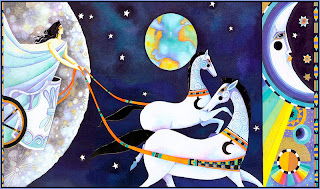
Imagen
Picture by/Imagen de Christina Balit In ancient Roman religion and myth, Luna is the divine embodiment of the Moon. She is often presented as the female complement of the Sun (Sol) conceived of as a god. Luna is also sometimes represented as an aspect of the Roman triple goddess (diva triformis), along with Proserpina and Hecate. Luna is not always a distinct goddess, but sometimes rather an epithet that specializes a goddess, since Diana and Hecate are  also identified as moon goddesses. Luna's Greek counterpart was Selene, and Diana's was Artemisa. The celestial character of Diana is reflected in her connection with moonlight, inaccessibility and her preference for dwelling on high mountains and in sacred woods. Diana therefore reflects the heavenly world in its sovereignty and supremacy but at the same time, she is seen as active in ensuring the succession of kings and in the preservation of humankind through the protection of childbirth. As a goddess of hunting, Di...

Translational and rotational movements / Movimientos de traslación y rotación

The Earth takes 23 hours 56 minutes exactly to turn fully around its axis, which passes through the poles, in west-east direction and in the opposite direction of clockwise. This is called rotation. In addition, this move gives us the feeling that the sky is swirling around our planet.The translational motion is an important movement of the earth, by which our planet moves around the Sun, driven by gravitation, in a time of 365 days, 5 hours and 57 minutes, which is the actual length of the year.The axis of rotation of the Earth is always pointing to an inclined direction. So when in its orbit around the Sun's north pole points toward the Sun, the northern hemisphere receives more heat, while in the Southern hemisphere we get some cold. Below you'll find a fun and short video that explains everything you need on the subject, I hope you like it. _________________ La Tierra tarda 23 h 56 minutos exactamente en dar una vuelta completa alrededor de su propio eje, que pasa ...